
Green & White Band
Packing lists
Real packing lists from the Green and White Band – with base weight, summer and winter benchmarks and the Big Three.
Packing list for hiking in the Swedish mountains →Key facts
- 25 real packing lists from Gröna Bandet (Grövelsjön–Treriksröset, approx. 1,300 km) and 3 from Vita Bandet on skis.
- Median base weight (excluding food, water and worn clothing) on Gröna Bandet: 6,15 kg.
- The lightest Gröna Bandet list has a base weight of 3,94 kg; the heaviest 11,54 kg.
Source: the Gröna Bandet survey and published LighterPack lists, compiled by GearGarage.
25 Gröna Bandet · 3 Vita Bandet · LighterPack
- Packing lists
- 25
- Lightest base weight
- 3,94 kg
- Median base weight
- 6,15 kg
Compare packing lists
First list
Second list
What is Gröna Bandet?
Gröna Bandet (the Green Ribbon) is a long-distance hike through the Scandinavian mountains between Grövelsjön and Treriksröset, following a self-chosen route rather than a fixed trail.
Gear is used day after day in real mountain conditions. Hikers’ experiences help us understand what lasts, works and feels good over time—not just what looks good on paper.
About Fjällfararnas Vita & Gröna Band ↗Green Band · survey 2026 · 62 answers
Lighter pack, higher satisfaction
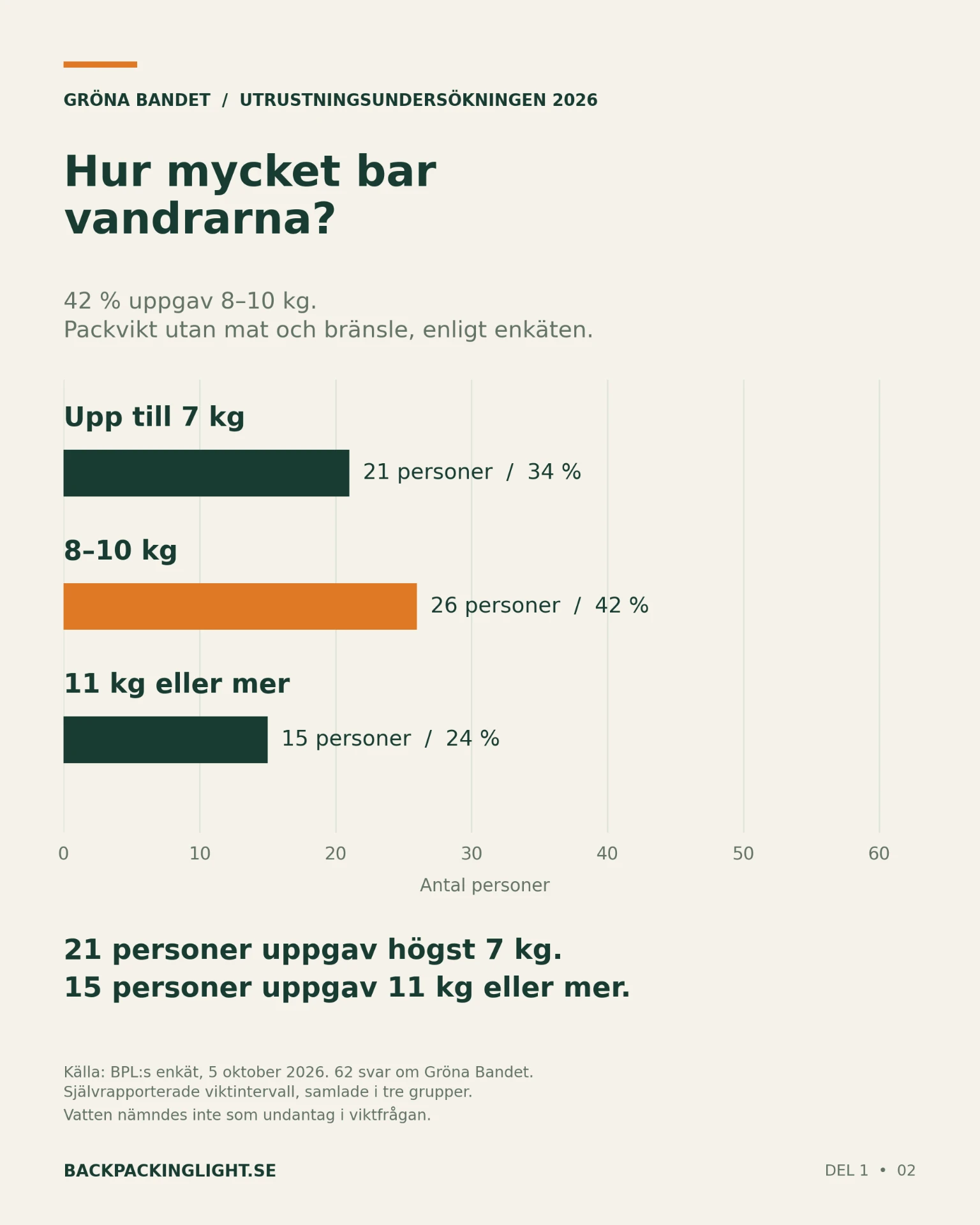
Hikers with a pack weight up to 7 kg rated their gear 8.6 out of 10 on average. Among those at 11 kg or more the average was 8.1. An inspiration to review your pack – without compromising warmth, comfort or safety.
Up to 7 kg · 21 answers
8,6 / 10
8–10 kg · 26 answers
8,4 / 10
11 kg or more · 15 answers
8,1 / 10
Start with the Big Three: shelter, backpack and sleep system. See what you actually use and where you can save weight before your next trip.
Review My packing listThe lists
Sorted from lightest to heaviest. Click to see the full list and copy it to your own.
Year not stated
Satu J.
3,94 kg
base weight · UL · 45 items
2020
Stefan S.
4,45 kg
base weight · UL · 60 items
2019
T. H.
4,60 kg
base weight · LW · 49 items
2021
David
4,63 kg
base weight · LW · 84 items
2026
Josefin S.
4,69 kg
base weight · LW · 74 items
2025
Anonym vandrare
4,85 kg
base weight · LW · 86 items
2026
Ludwig Ö.
4,91 kg
base weight · LW · 56 items
2025
Kåre F.
5,33 kg
base weight · LW · 110 items
2025
Benjamin U.
5,52 kg
base weight · LW · 54 items
2025
Viktor Z.
5,92 kg
base weight · LW · 78 items
2026
P. B.
6,06 kg
base weight · LW · 86 items
2023
Anders N.
6,12 kg
base weight · LW · 104 items
2024
Lisette K.
6,15 kg
base weight · LW · 76 items
2024
Christer S.
6,22 kg
base weight · LW · 136 items
2025
Anonym vandrare
6,31 kg
base weight · LW · 72 items
Year not stated
Anonym vandrare
6,36 kg
base weight · LW · 66 items
Year not stated
Peter S.
6,45 kg
base weight · LW · 43 items
Year not stated
Olsson
7,31 kg
base weight · LW · 96 items
Year not stated
Olsson
7,42 kg
base weight · LW · 78 items
Year not stated
Anonym vandrare
7,83 kg
base weight · LW · 45 items
Year not stated
Satu J.
8,21 kg
base weight · LW · 53 items
Year not stated
Anonym vandrare
8,37 kg
base weight · LW · 56 items
2026
J. L.
10,47 kg
base weight · Traditionell · 143 items
2024
Anonym vandrare
11,02 kg
base weight · Traditionell · 94 items
2026
Jens S.
11,54 kg
base weight · Traditionell · 136 items
What the survey shows
More results from the 2026 survey with 62 answers from the Green Band.
Tips before you head out
Start from your trip
Thru-hikes, weekend trips and camp life have different needs. Choose for weather, terrain and your needs – not the lowest weight at any cost.
Weigh first, cut later
Weigh every item, including what you wear. Start with needless duplicates and things you never use; keep gear for safety and unexpected weather.
Start with the Big Three
Review shelter, backpack and sleep system. Around 3 kg combined is a benchmark for a lighter three-season pack, not a rule. Size, cold and comfort matter.
Prioritise sleep
Choose your sleep system for the expected night cold and how easily you get cold. Use the comfort rating where given and a well-insulated pad.
Try lighter shoes
Light hiking shoes or trail runners may suit your trip. Prioritise fit, grip and protection; test with a loaded pack and don't switch to new shoes just before leaving.
Try hiking with poles
Poles give support, balance and relief on slopes. Practise technique and length. In a trekking-pole tent they can replace tent poles – check they fit.
Choose the backpack last
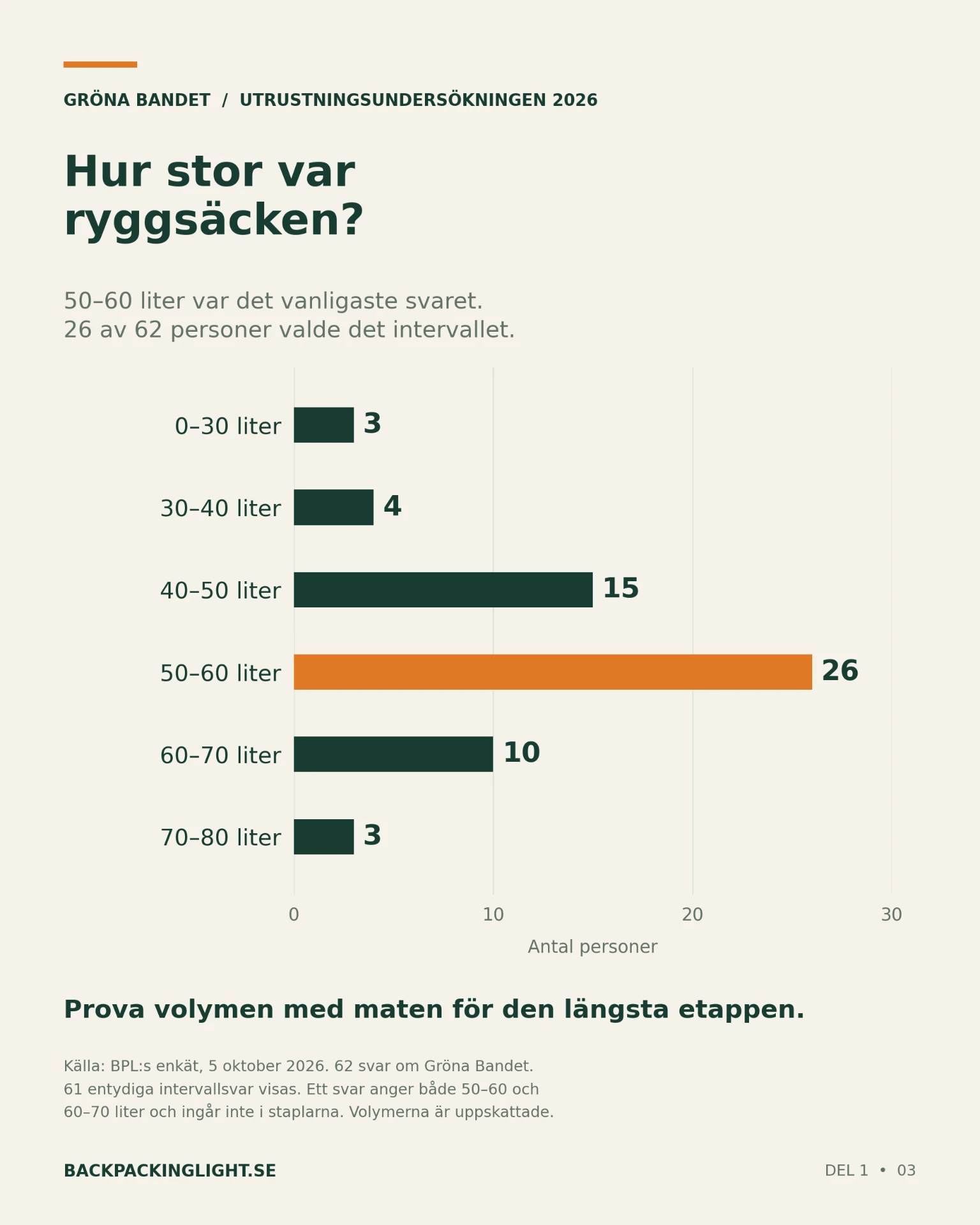
Once the rest is decided you know the volume and load you need. Try it with food and water for the longest leg and follow the recommended max load.
Share what you can
A shared tent and stove can cut weight per person. Decide who carries what and what each needs if you split up.
Test everything first
Sleep a night in the tent, walk a weekend with a full pack and learn to repair what can break.
Rain gear is the weakest link
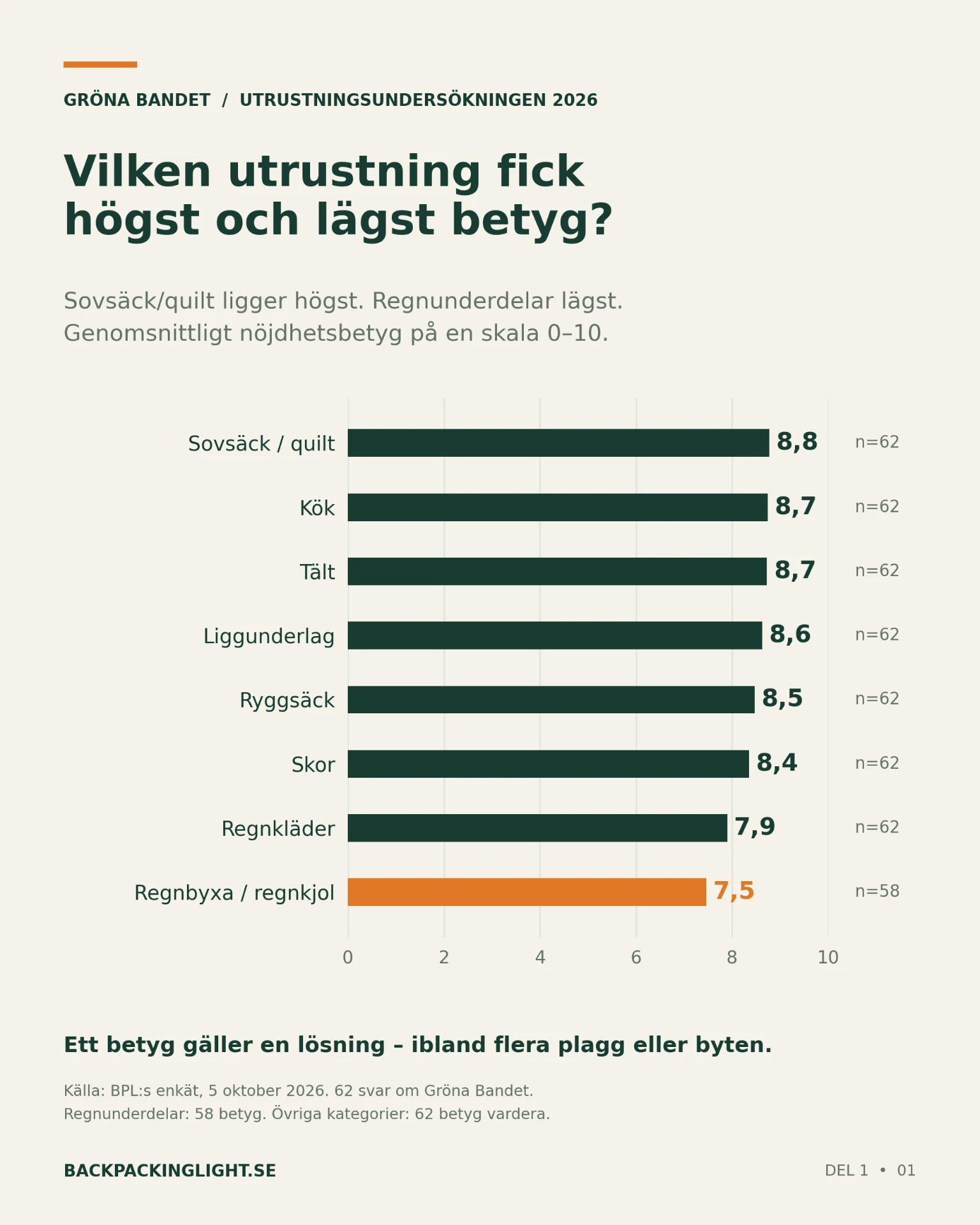
Rain pants and rain skirts got the lowest ratings. Take time choosing them.
Plan food drops
Fewer days of food in the pack means a lighter load. Check shops and parcel pick-ups along the route.
The method holds even as products change
The advice on needs, shoes, poles and choosing a backpack is adapted from Marcus Falck's 2022 article (in Swedish). Product models, images and specs in the original may be outdated. Here we focus on the approach, not older product recommendations or exact energy-saving claims.
Read Marcus's article: Five light tips (2022, Swedish) ↗